

The Most Accomplished Bowhunter You’ve Never Heard Of
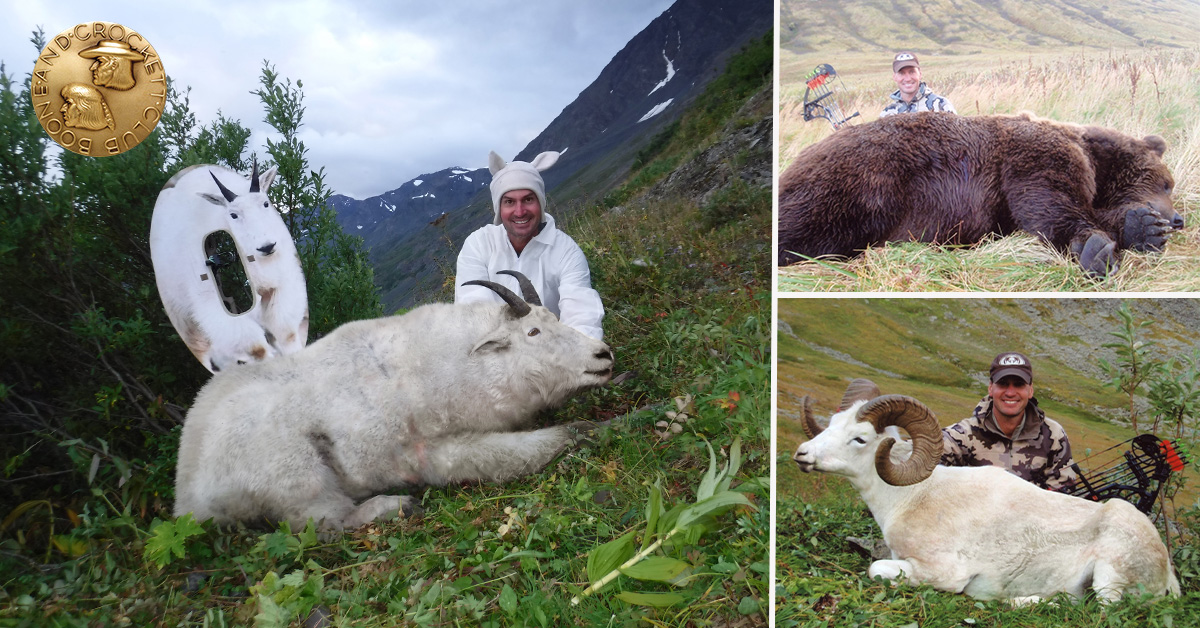
Frank Noska wears a white Tyvek painter’s suit and a “simple hat,” something he’ll put on anytime he’s hunting country where blending in matters. Like most things he does, it’s less about novelty and more about getting close. He's pictured here with a goat from 2024, a 2013 Alaska brown bear, and a 2012 Alaska Dall's sheep.
How Frank Noska Built a Life Around the Hunt
By PJ DelHomme
In the halls of bowhunting greatness, names like Saxton Pope, Art Young, Fred Bear, and Chuck Adams are considered royalty. And then there’s 59-year-old Frank Noska.
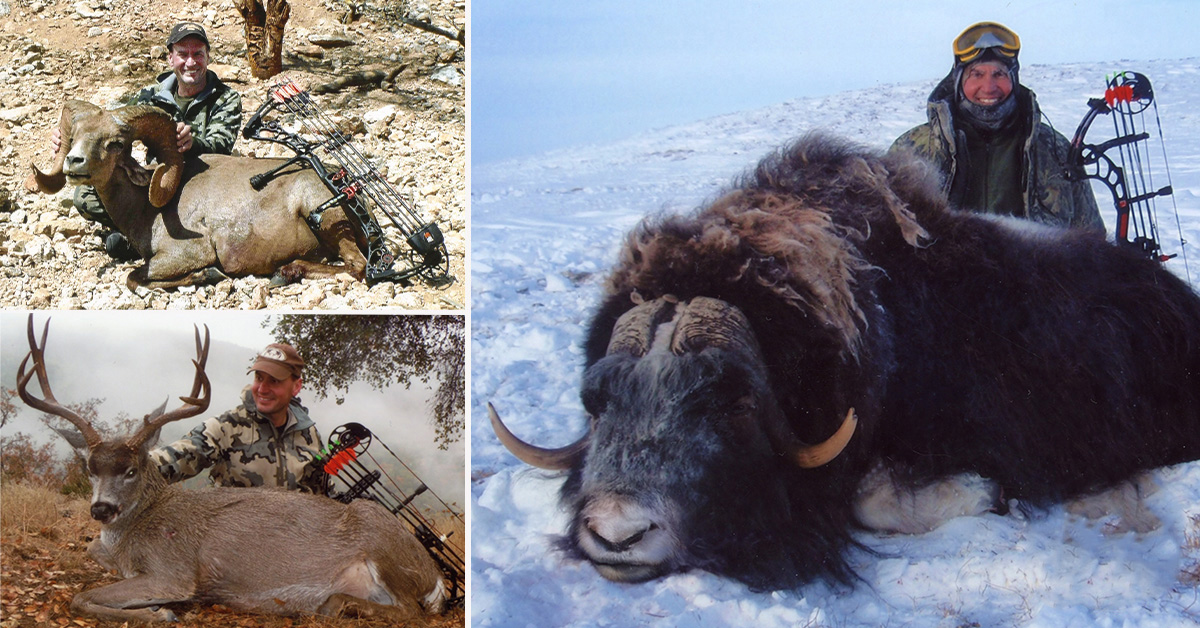
Start digging into the record books, and Frank Noska appears next to more than 44 entries in the Boone and Crockett records and well over 200 times in the Pope and Young record book. Those numbers put him in the running for most entries in either record book, and he's not done. He’s completed two North American Super Slams—all 29 recognized species of big game—with a bow. This fall, he’s chasing Roosevelt’s elk and a woodland caribou to finish number three.
He didn’t stack those numbers in the short run. He’s been entering animals since his 1994 Pope and Young Colorado pronghorn. The numbers (and his relative obscurity) raise a simple question: who, exactly, is Frank Noska?
He’s a cargo pilot for UPS who lives in Alaska and built his life around bowhunting. He isn’t into self-promotion. He prefers to hunt solo, unguided. He’s written a few magazine articles, and he volunteers as an Official Measurer for Pope and Young and Boone and Crockett. In between, he hunts everything from record-book polar bears in the Arctic to Coues’ deer in Mexico—all while holding down a full-time job.
Is Frank Noska the most accomplished bowhunter of all time? “He is certainly one of the most accomplished bowhunters in the modern era,” says Justin Spring, Pope and Young Club Executive Director.
To understand what makes Frank tick (and why he’s so good at bowhunting), I spent six weeks tracking him down. It took rotator cuff surgery to slow him long enough for a video call. What I found was a down-to-earth, driven hunter who has made bowhunting his life’s passion.
A Career Built for Hunting
For the past three decades, Noska has flown cargo jets for UPS, working his way up from small commuter aircraft to wide-body freight haulers. It’s a demanding job that’s the backbone of a serious hunting addiction.
“It’s enabled me to live this lifestyle,” he says. “There’s lots of time off, and I make enough money to do these hunts.”
Time and money—constraints that limit most hunters—are managed variables in Noska’s life. His schedule creates blocks of uninterrupted days or weeks that can be spent in the field. Plus, being a pilot in Alaska also has its upsides. Frank owns multiple Super Cubs—those small, rugged aircraft built for short takeoffs and landings in rough country.
“They’re my tools,” he says. “Like an air tractor.” Aided by his air tractors, Noska can fly into Alaska’s remote backcountry, hunt until he’s content (or until the weather allows a safe departure), and be back at work on schedule.
Noska didn’t end up in Alaska by accident. He grew up in North Texas, where he taught himself to hunt with a bow. He killed deer with a rifle as a kid but hasn’t taken a big game animal with one in more than four decades.
“If I’m going to do it, I’m going to do it with a bow.”
In college, he began flight training, building his aviation career from the ground up through civilian routes and early commuter airline jobs. He moved to Alaska in 2001 for the bowhunting.
When he hunts for moose, bear, and deer, Noska doesn’t mind going with a buddy or two. But on his most difficult hunts for sheep, goats, and brown bears, Noska prefers to hunt alone.
“I like to go by myself. I mean, I’ve got places I want to look, but there’s no real plan—you just make decisions on whatever cards you’re dealt. Most times, I don’t even know where I’m going to sleep. I’ve got my pack and my tent, and I’ll just find the right spot—it kind of shows itself to you. Some guys ask how you can be out there for 10, 12, or 14 days and not talk to anybody, but I enjoy it. I don’t have to worry about other people, and if a hunt takes longer than I thought, I can just stay with it.”
As we spoke, I got the sense that hunting solo wasn’t about isolation for its own sake. Rather, it’s more about efficiency. Schedules don’t compete, nor do expectations. He moves at his own pace, makes his own calls, and accepts the consequences, which can make for fun, albeit terrifying, stories—like the time he got roughed up by a brown bear sow with cubs.
He had been in Alaska for only a few years. On a Dall’s sheep hunt, he was dropping out of high, open country and walked straight into a sow with cubs. There was no time for a firearm, no tree to climb, no margin. With only the ice axe in his hands, he swung it like a bat and struck the sow as she charged. This deflected the charge, but she knocked him down. He stayed down, face to the ground, an old Kelty frame pack between him and the angry sow. He watched from the corner of his eye as she circled, jaws popping, weighing whether to finish him or get back to her cubs. Then, just as suddenly, she gathered her cubs and left. Shaken and a tad stirred, Noska got up. Had the sow decided on plan B, that solo hunt might have been his last.
Volunteering as an Official Measurer
For all the entries tied to his name, Noska has spent decades volunteering as an Official Measurer for both Boone and Crockett and Pope and Young, a role he’s held since 1999.
“After a dozen or 20 animals that a guy measured for me, I got interested in it myself,” he says. “I did a lot of research and asked about becoming a measurer, and he kind of sponsored me and got me into a class.”
It’s detailed, largely unseen work. In Alaska, it often means meeting hunters wherever they are—a garage, a hangar, a parking lot. “I do a lot of stuff other measurers won’t do. I’ll go to people’s houses, measure a moose on the wall, meet somebody in a parking lot, and measure a bear on a tailgate—whatever makes it easier on them.”
The Noska Mindset
Frank Noska does things his way. And it seems to work because the numbers are difficult to ignore. Volume tells only part of the story. What matters more is the consistency. Decades of success across species that demand completely different approaches—sheep in steep, exposed country, bears in thick coastal cover, Coues’ deer in dry, open terrain.
He’s quick to point out that nothing works without the right mindset. The physical side matters, but it isn’t what carries a hunt when things go sideways. “A lot of these hunts, it’s mental strength more than physical strength,” he says. “You’ve got to stay positive, solve problems, and get through the night. You’ve got to believe you can do it.”
In looking at Noska’s Boone and Crockett entries, you’ll notice that he hunts the extremes—far north and far south. The Lower 48 doesn’t appear to be on his to-do list. I asked him about it.
“I think the reason that I mainly hunt a lot in Alaska and Mexico is that I get to do it on my own. I get to do my own planning, my own camp, my own logistics—I like to have my hands in all of it,” he says. I’ve just been a do-it-yourself guy my whole life.”
To be fair, he does hunt whitetails in the lower 48. “I’ll never tire of that. But here in Alaska and down south, I get total control of the hunt, and I think that’s what really draws me.”
The other thing that draws Noska is getting close to his quarry. In an era where equipment continues to extend effective range, his approach moves in the opposite direction. Distance isn’t something to maximize—it’s something to eliminate.
“I like getting close—that’s what attracted me to bowhunting,” he says. “I’ve never been a real long-range shooter like some of my buddies, but I am pretty good at sneaking around and stalking in on animals. I joke with those guys all the time. I might not shoot them at a hundred yards like they can, but I bet they can’t get to 15 yards like I can. That’s just always been my deal. I’d rather figure out how to close that distance than try to stretch it.”
Ask Noska about success, and he doesn’t point to talent or opportunity. He points to preparation.
“Luck comes from preparation. It follows people who are prepared and who try the hardest.”
It’s a simple idea, but it explains the pattern. The job that provides time and income. The move to Alaska. The decision to hunt solo. To hunt with a bow. The willingness to stay longer, go farther, and get closer.
So the question remains: Is Frank Noska the most accomplished bowhunter of all time?
There’s no clean way to answer. Too many variables. Too many definitions of what “accomplished” really means. But if the measure is consistency, grit, and determination, then he belongs in that conversation—whether most hunters recognize the name or not.