

The Great Wildlife Restoration
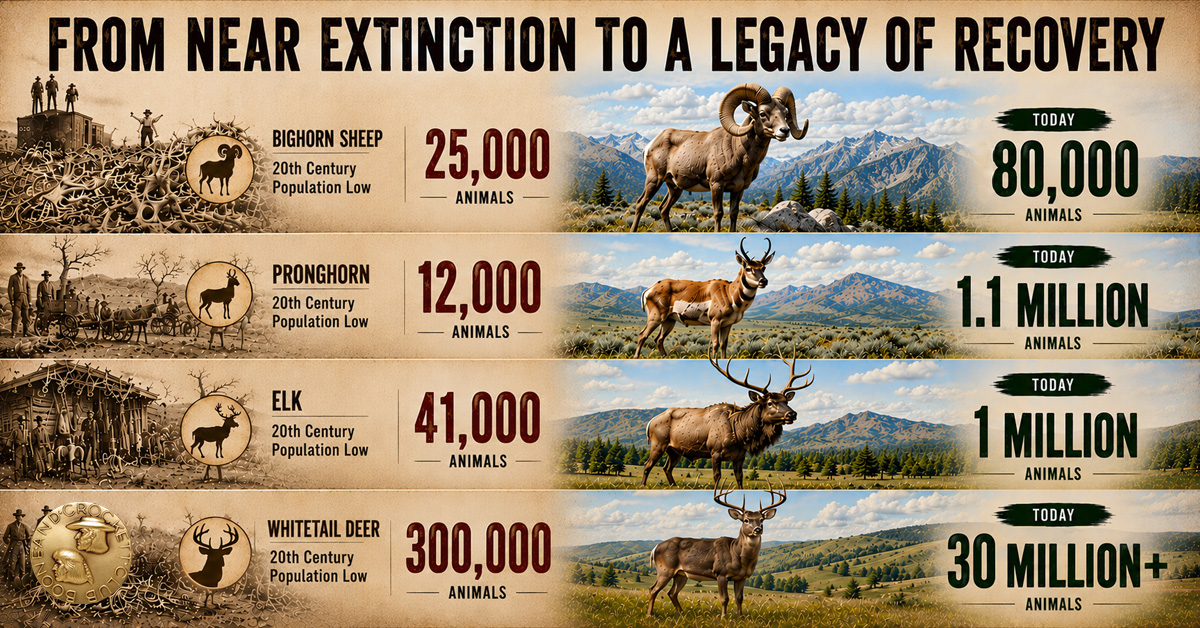
In 1887, they counted what was left. Today, we count what came back.
When the Boone and Crockett Club was founded in 1887, conservation wasn't about managing abundance. It was the opposite. The founding members of the Boone and Crockett Club were conducting wildlife triage across an entire continent.
The transformation from that low-water mark to the robust populations we hunt today is the result of a deliberate, hunter-funded policy shift. By removing wildlife from the market and placing it into a public trust, hunters traded short-term exploitation for a century of reinvestment. We’ve gone from counting what was left to managing the surplus for the next generation.
The Recovery: By the Numbers
Species | Est. Original Population | Recorded Low (1890-1920) | Current Est. Population |
Wild Turkey | 10 million | 200,000 | 6-7 million |
Whitetail Deer | 30 million | 300,000 | 30 million+ |
Mule Deer | 10 million | 40,000 | 3.2 million |
Rocky Mtn. Elk | 10 million | 41,000 | 1 million |
Pronghorn | 35 million | 12,000 | 1.1 million |
Black Bear | 2 million | 200,000 | 900,000 |
Bighorn Sheep | 2 million | 25,000 | 80,000 |
Bison | 30-60 million | 541 | 400,000* |
These figures represent the trajectory of North American game species from their estimated pre-colonization levels to their lowest recorded points, and finally to the sustainable populations we maintain today.
For numerous species, non-profit organizations were founded by hunters and other wildlife lovers. For instance, the American Bison Society worked to restore bison herds, and Club members Charles Sheldon and T. Gilbert Pearson worked to create refuges for pronghorn and other wildlife.
More recently, organizations like the National Wild Turkey Federation, Wild Sheep Foundation, Rocky Mountain Elk Foundation, and the Mule Deer Foundation each have dedicated staff and members who raise money to benefit their species namesake. And because conservation doesn’t happen in a vacuum, other species benefit from their habitat enhancement projects, too.
The Role of Policy and Legislation
The recovery of big-game populations was not an accident. It took leadership, legislation, and money. The Lacey Act of 1900 provided the teeth to end market hunting, but the Pittman-Robertson Act of 1937 provided the fuel to fund wildlife restoration. Fun fact: P-R’s official title was the “Federal Aid in Wildlife Restoration Act of 1937.”
P-R placed a self-imposed excise tax on gear like rifles and ammo. By doing so, hunters created a dedicated funding stream that cannot be diverted by the whims of a general fund.
Today, that "user-pay, public-benefit" system generates roughly $1.6 billion annually. This money funds the biologists who set season dates, the technicians who manage winter range, and the wardens who protect the public trust. It is the only model in the world where the very people who pursue the resource are the ones most invested in its expansion.
Typically, in mid-January, state legislatures convene across the country. Lawmakers review and debate legislation that involves funding for wildlife and wild places. At the Boone and Crockett Club, we engage those policymakers on behalf of our constituents—hunters like you—just as we have since our founding in 1887.
Recovering wildlife populations from the lows of the late 19th century did not happen overnight. It took generations to create the bounty we enjoy today. And this is reason to celebrate, but it’s not a reason to slow down.
*The bison total reflects both wild and domesticed herds in North America