

Elk Steak Goes Sci-Fi: Does Lab-Grown Meat Make Fair Chase Obsolete?
By Steve Wagner
Bioengineers are making lab-grown elk meat. It’s molecularly identical to wild meat—but are you really eating the same thing?
Elk steaks sizzle over a crackling fire. For 10,000 years, this primal cookout required three things: an elk, the skills of a hunter, and a skosh of luck.
Today, meh. Luck is no longer a prerequisite, since elk can be unfailingly harvested in high-fence enclosures. Even the most skilled of fair-chase hunters is now functionally obsolete, because commercial elk farms keep supermarkets and restaurants stocked with fresh venison, no hunting necessary. And, in the newest shock to time-honored sporting traditions, soon our sizzling elk steaks won’t even require an actual elk!
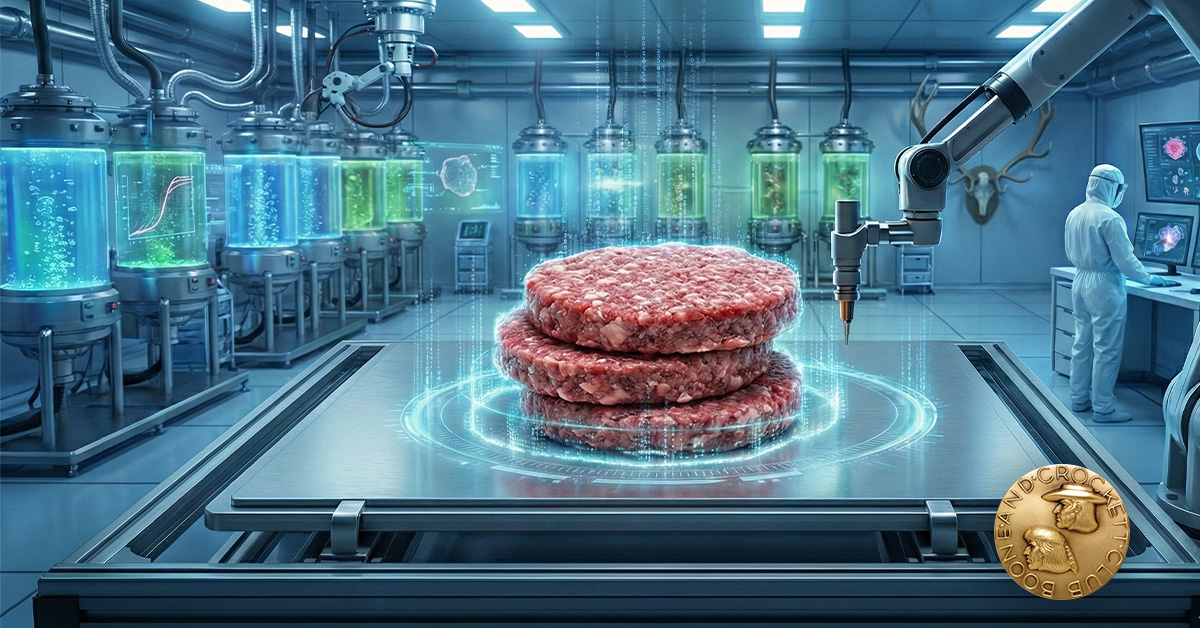
Biotech companies are developing ways to mass-produce elk steaks in a lab, using cell cultures that grow into tissues molecularly identical to meat made the old-fashioned way by Cervus canadensis.
The company has attracted investment from the same venture capital firms that helped launch Airbnb, DoorDash, Reddit, Dropbox, Instacart, artificial intelligence, and self-driving car technologies, as well as dozens of food tech startups worldwide. The company, formerly Orbillion Bio, attracted so much interest that it was recently purchased for $100 million.
In the corporate rush to scale up production of elk meat “products,” are we diluting what once was so special about the real thing? Are we losing our last connection to the wild? Our respect for big game animals was once so strong that it inspired us to harvest them only in the highest ethical way. Is that old reverence becoming blasé?
Here’s a look at the past, present, and potential future of cultured meat—a weird, wildly fascinating and somewhat worrisome topic.
From Petri Dish to Dinner Plate
In 1931, British statesman Winston Churchill predicted that within 50 years, society would gain a better understanding of science and how to harness it to “escape the absurdity of growing a whole chicken to eat the breast or wing, by growing these parts separately under a suitable medium.” Turns out, Churchill’s vision was correct, although he missed the timeline by 32 years.
It was 2013 when the world’s first lab-grown meat product, a hamburger, was fried up in London on live television for a panel of taste testers. They seemed impressed. However, the inventors, scientists at a local university, spent $325,000 and two years producing the patty.
Over the next several years, many companies began working to simulate beef, chicken, and fish on an industrial scale. The biggest breakthrough was Impossible Foods, which in 2019 partnered with Burger King to introduce the lavishly promoted Impossible Whopper. The patty was entirely plant-based. Opinions varied on how closely the taste and texture resembled real beef, and then a COVID-fazed public soon lost interest.
Behind the scenes, bioengineers were scrambling to culture a new substance that more closely mimics real meat—because it is, actually, meat.
Meat Breweries
Today, lab-grown meat starts as a line of cells collected from an animal, like a biopsy. Cells are then coaxed to multiply and grow by suspending them in a cocktail of hormones and nutrients inside stainless-steel vats called bioreactors, similar to the giant vessels in a beer brewery. Muscle, fat, connective tissue—most of the components of natural meat—can be cloned together as a single mass. Potentially, bone and blood could be part of the product someday. Established cell lines can be kept, cultured, and used indefinitely. Think sourdough bread starter, but for loaves of roast.
Proponents say the process avoids the environmental impacts of raising and transporting livestock. It uses less land. It requires no animal slaughter. There are no antibiotics. Sterile lab environs reduce the risk of bacterial pathogens such as E. coli or Salmonella. Earth’s human population is projected to grow by billions of hungry mouths over the next quarter to half century; cultured meat could become an efficient way to feed ourselves.
Early taste testers report that the flavor is generally good but somewhat generic, lacking the nuanced flavors of natural meat. Textures are often described as too loose or even gelatinous. Engineers are addressing these issues using digital sensory equipment and testing new formulas, determined to develop a scalable, profitable product that is indistinguishable to the human palate.
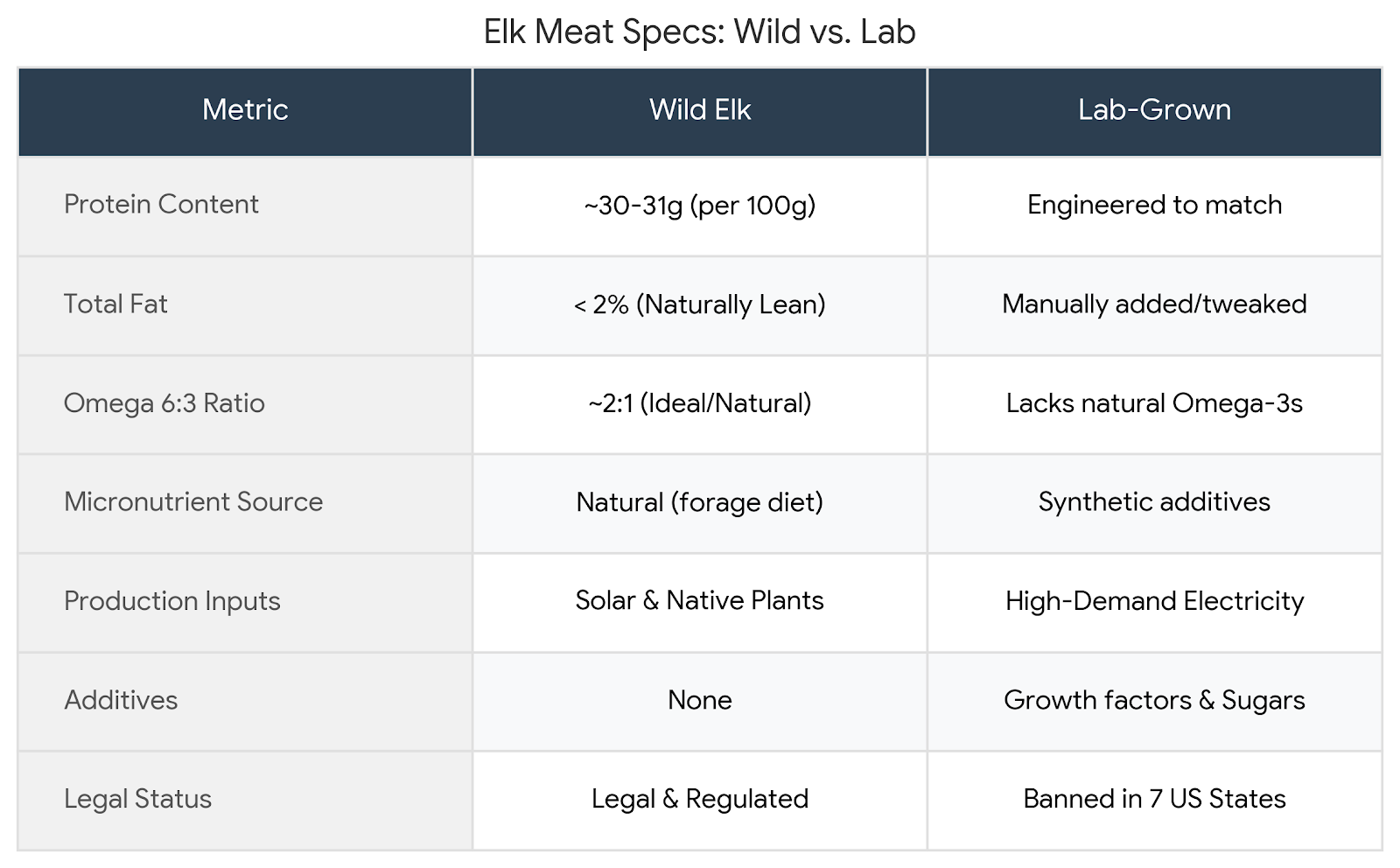
And then there are the unknown nutritional benefits of lab-cultured meat. We know wild, free-ranging big game is good for us, but there is little to no information available on bio-elk.
Table quality aside, other critics point out that manufacturing requires exorbitant power consumption, offsetting the smaller environmental footprint. Consumer costs are higher. As some in society move toward ancestral diets and away from ultra-processed foods, here come arguably the most man-made and manipulated products of all.
There’s also the hurdle of approval by the U.S. Food and Drug Administration. To date, only two companies have attained regulatory approval to sell lab-grown meat. Their small-batch beef, chicken and fish outputs are served mostly in trendy West Coast bistros.
In 2025, Texas became the seventh state to ban these products altogether. Others include Alabama, Florida, Indiana, Mississippi, Montana, and Nebraska. Bans are being pushed by cattlemen's associations to help protect traditional agriculture and commerce—and ranchers may be right to worry. Remember the Impossible Whopper? Parent company founder Patrick O. Brown of Impossible Foods has repeatedly stated that his ultimate goal is “putting the beef industry out of business.”
Perhaps big game hunters and conservationists should feel threatened, too.
Fake Elk and Fair Chase
With a global beef market valued at more than $436 billion, why would a food tech company want to specialize in elk? A unique and profitable niche? Before it was purchased, Orbillion Bio stated on its now-defunct website that it intended to focus on high-end, hard-to-find meats such as elk, bison, Wagyu beef, and lamb.
Let’s say this idea of lab-grown meat (of any kind) takes off. What does that mean for ranchers and their herds? No one’s really discussing how mass bankruptcies in the rural West might, in turn, hit wild elk herds, which increasingly rely on habitat stewarded on private lands.
Even bigger, more philosophical questions loom: What does this mean for the future of hunting and Fair Chase? This is especially concerning if you’re a hunter (like me) who believes that consuming wild elk provides your family and friends with a type of nourishment that science can’t measure.
We’re ingesting into our own cells a creation purely of the good earth. An animal that lived its life unfettered. Wild. Free and independent and strong, with organic immunities and fitness borne of forests and meadows and streams. Lineage built by generations of natural selection; evolved instincts honed by actual lived experiences.
There’s a spiritual connection to wild-sourced elk meat that lasts long after the sizzles and flames have cooled. It goes far beyond simply satisfying a mealtime pang. It is something that inspires hunters—in ways that farm-raised steaks never have, and lab-grown steaks never will—to give something back to the wild places and wild creatures that have sustained us for the better part of 10,000 years.