
Boone and Crockett’s Top Whitetail States: Latest Rankings
For decades, the whitetail record-book map was static. You hunted Iowa, you dreamed of Wisconsin, and you ignored the rest. In our all-time analysis of whitetail record-book entries from 1830 through 2019—drawn from Records of North American Whitetail Deer, Sixth Edition—the historical top tier looked familiar: Wisconsin, Illinois, Iowa, Minnesota, Ohio, and Kentucky.
Times have changed.
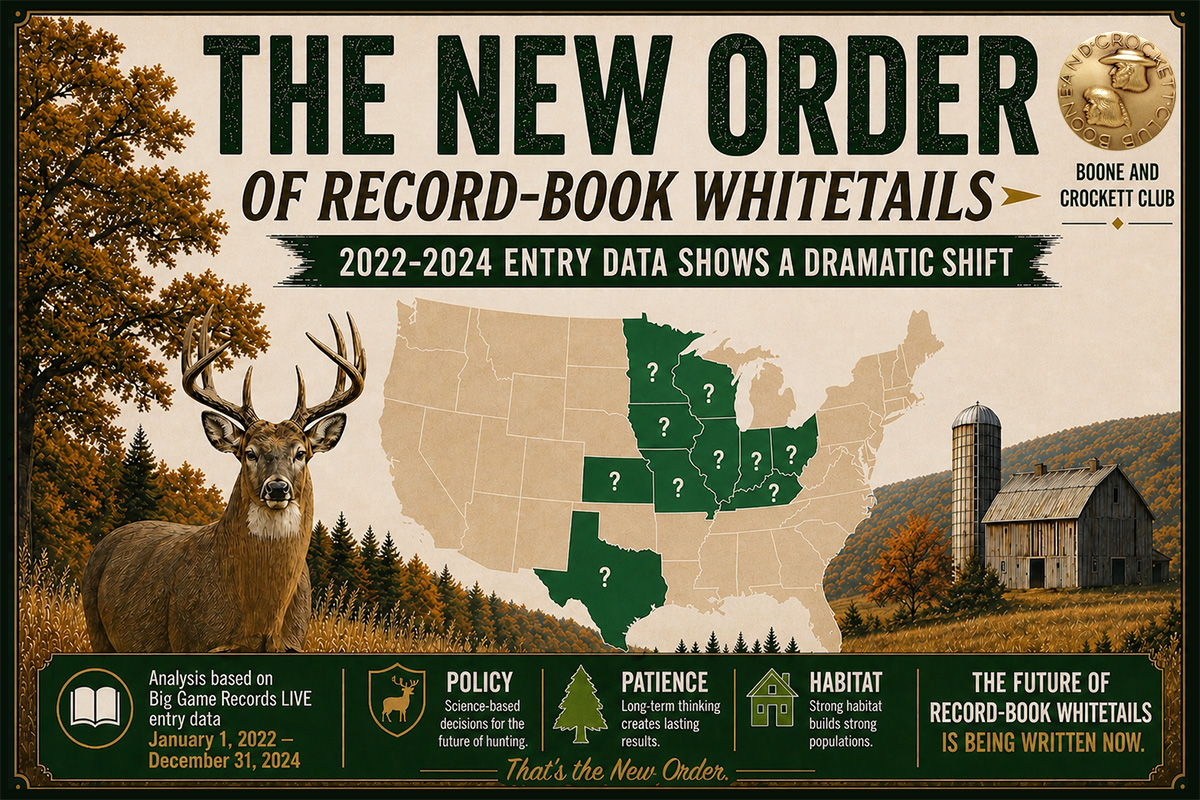
Using Big Game Records LIVE entry data from January 1, 2022, through December 31, 2024, the current picture of trophy whitetail production looks dramatically different from the historical record. Wisconsin still sits at #1 — as it has in every modern edition of the B&C records. But behind Wisconsin, the order has reshuffled in ways that would have been unthinkable a generation ago. Indiana has climbed from the bottom of the top-10 to #2. Ohio has surged to #3. And a cluster of Corn Belt states — Iowa, Illinois, and Kentucky — is locked in a tight three-way contest for #4.
Here's what the current numbers say.
1. Wisconsin
First things first. Wisconsin is still the king, and Buffalo County remains the epicenter. The Badger State has finished #1 in every modern cycle of the records, and the current cycle is no exception — 135 entries, nine ahead of second-place Indiana. The reasons? Wisconsin's Driftless Area in the state's western third offers a rare combination of steep ridge-and-coulee topography, mineral-rich soils, and agricultural edge habitat that lets bucks survive to the 5½- to 6½-year-old age class required to grow book-caliber antlers. Stack that on top of a deep hunting culture, a statewide firearms harvest that still leaves mature deer on the landscape, and county-by-county management that has increasingly favored age structure over harvest volume, and the result is the most productive trophy-whitetail state in the country. Fun fact: Wisconsin has more than 6 million acres of public land. Compare that to roughly 1 million acres each in Indiana and Ohio.
2. Indiana
Indiana's climb is the most notable in the current data. In the all-time records through 2019, the Hoosier State ranked #10. Today it sits at #2 with 126 entries—just nine behind Wisconsin. The jump reflects a number of factors, namely reduced antlerless harvest in key southern counties and a landscape of mixed hardwood-and-agriculture habitat that produces the nutrition and cover bucks need to reach maturity. Indiana’s strict one-buck-per-year limit is a primary driver—just ask Dustin Huff with the third-largest typical whitetail of all time.
3. Ohio
Ohio rounds out the top three with 125 entries — just one entry behind Indiana and ten behind Wisconsin. In the all-time records through 2019, Ohio ranked #5; today it sits at #3, and the gap has been closing steadily for more than a decade. The single factor most often credited for Ohio's climb is its one-buck rule: regardless of how many tags a hunter holds, only one antlered deer may be taken per license year. Layer that regulatory foundation on top of Ohio's rich agricultural edge habitat, a strong hardwood mast crop across much of the state, and the result is a state that produces big bucks consistently across a wide geography rather than concentrated in a handful of hotspot counties. Ohio doesn't need the Driftless terrain that built Wisconsin's dominance. It has instead built its trophy reputation on policy and patience. The numbers show it's working.
4. Iowa
Iowa sits at #4 with 107 entries. In the all-time records, the Hawkeye State ranks #3 historically—a reflection of decades of legendary big-buck production, anchored by the Driftless bluff country in the northeast. That's the same unglaciated region that anchors Wisconsin's dominance, offering steep ridges, deep timbered valleys, and the agricultural-edge habitat mature whitetails require. Allamakee County, in particular, has long served as Iowa's answer to Buffalo County, Wisconsin, consistently posting bucks that rank among the records. But Iowa's real edge isn't just geography—it's policy. The state's strict nonresident license draw, which caps out-of-state tags at a low percentage and requires multi-year waits for many applicants, keeps hunting pressure meaningfully below that of other whitetail powerhouse states. Fewer hunters in the woods means more bucks survive their third and fourth fall, which is when B&C-caliber antlers start to appear.
5. Illinois
Illinois sits at #5 with 105 entries—just two entries behind Iowa. Illinois has always produced giants, particularly in the non-typical category, where its river-bottom hardwoods along the Illinois and Mississippi valleys regularly yield bucks pushing past 200 inches. But the last three years show the state is no longer just producing a handful of headline-grabbing outliers. The combination of rich agricultural edge, mature timber blocks in the western counties, and a cultural shift toward passing younger bucks could propel Illinois into the top three very soon.
How the Rankings Have Shifted
Entry Data January 1, 2022, to December 31, 2024
Trends of Note
Kentucky holds the same #6 position it occupied in the all-time historical records. The state has never been the flashiest trophy destination, but it has been one of the most reliable. Decade after decade, Kentucky produces book bucks at a steady, predictable rate without dramatic peaks or collapses.
Missouri (69 entries, #8) has joined the top 8, just one entry behind Minnesota. The Show-Me State has been producing quality bucks for years along the Missouri River corridor. Missouri's one-buck antler-point restriction in many counties, combined with the expansion of public land acreage, puts the state on a trajectory similar to Indiana's 15 years ago. Don't be surprised if Missouri pushes into the top five in the next few years.
Kansas (63 entries, #9) has always punched above its weight on a per-hunter basis, and it’s one strong season away from breaking the top eight. Kansas produces a disproportionate share of truly giant non-typicals—the kind of western-plains buck with the genetics and low-pressure habitat to reach scores other states rarely see. The state's limited nonresident draw, similar in philosophy to Iowa's, preserves the age structure that makes those outliers possible.
Texas (60 entries, #10) rounds out the top 10. The Lone Star State remains home to enormous acreage, strong management programs, and some of the most intensively managed low-fence deer habitat in the country, but this entry cycle was relatively flat.
The Importance of Records in Big Game Management
When you enter your trophy into the Boone and Crockett system, you aren’t just honoring the animal and its habitat. You are participating in a data collection system that started in the 1920s and was refined by Club members in 1950.
Today, there are nearly 60,000 trophy records. By establishing a records database more than 70 years ago, the Boone and Crockett Club established a scientific baseline from which researchers can use to study wildlife management. If you’re still on the fence about entering your trophy, we encourage you to read Why Should I Bother to Enter My Trophy. To the best of our ability, we ensure that the trophies entered into the records were taken in accordance with the tenets of fair chase ethics. Despite what some may think, the Boone and Crockett records are not about a name or a score in a book—because in the end, there’s so much more to the score.