
The Boone and Crockett Club cheered the infusion of new funds available for big game migration habitat conservation and restoration announced today as part of the Make America Beautiful Again Commission. To support this core sportsmen’s priority, almost $8 million has been added to the $2 million in base funds available this year through the National Fish and Wildlife Foundation (NFWF) for their Western Big Game Seasonal Habitat and Migration Corridors Fund. Private and tribal funding is also included in the total.
Projects funded by the program improve habitat in priority areas identified by state wildlife agencies to address the needs of big game species as they travel to and stopover in their summer and winter range habitats.
“The migration corridors program began in 2018 as a proof-of-concept for a few species of big game. Having continued ever since, it has now proved the concept,” said Simon Roosevelt, Executive Vice President of Conservation at the Boone and Crockett Club. “The Trump administration, Secretary Burgum and Director Nesvik in particular, has recognized this and we look forward to further expansion of this invaluable effort. More species, and more areas – especially in summer ranges – need to benefit from this work.”
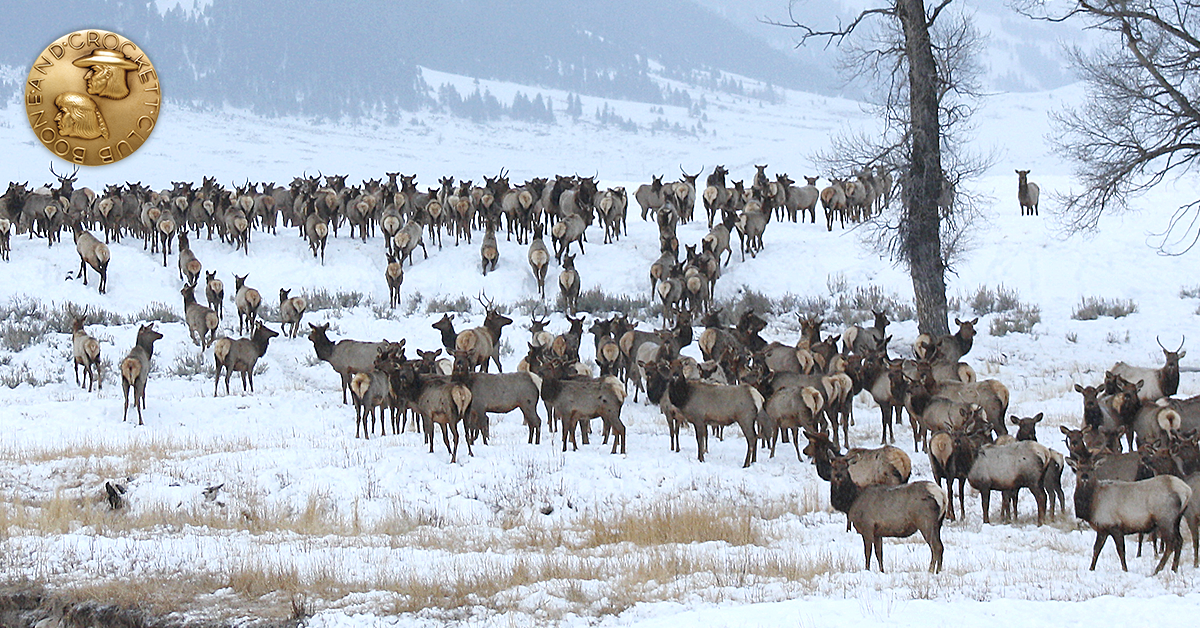
Big game such as elk, mule deer, and pronghorn are iconic species in the West, providing important hunting and recreational opportunities and contributing a vital source of protein for western ecosystems. The success of their movements requires quality habitat along the migration routes and seasonal habitat they depend upon. Since Secretary’s Order 3362 was signed in 2018, there have been seven rounds of NFWF grants awarding $21.6 million across 86 projects, leveraging $67.2 million in matching contributions to generate a total conservation impact of more than $88.9 million. These projects have protected private land through conservation easements with willing landowners, addressed barriers through road crossings and wildlife-friendly fencing, and restored hundreds of thousands of acres of habitat. The nearly $10 million available for the 2026 funding cycle will be the most for a single round since the program began.
“The renewed attention to this program and significant influx of funding will enable state agencies, tribes, hunting groups, and other partners to expand the results and scope of the program,” Roosevelt continued.
In addition, the Boone and Crockett Club is looking forward to more conservation leadership through the Make America Beautiful Again (MABA) Commission.
Roosevelt concluded, “Making stewardship of our natural resources the means of driving economic growth ensures the satisfaction of needs today and in the future. Access, voluntary conservation, faster agency action, and species recovery all encourage momentum for Theodore Roosevelt’s vision that conservation is a national priority. The MABA commission’s direction moves all agencies toward many more objectives like migration habitat, and we look forward to working with the Administration to achieve these goals.”